
Inspiring the Builders of Tomorrow: CIRA’s Outreach to Secondary Schools in Dowa and Lilongwe

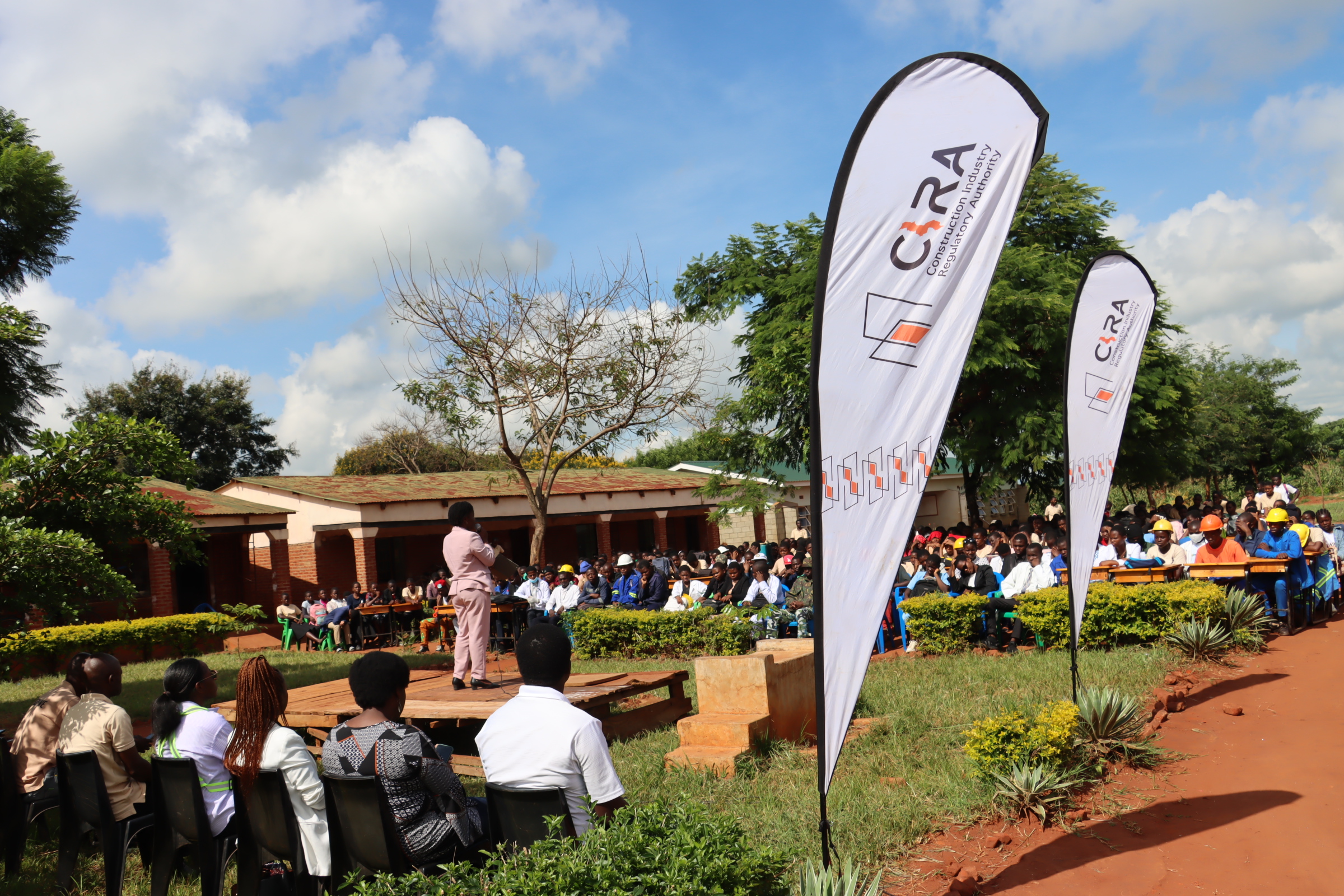
As the clock ticked towards quarter to 9 in the morning on Wednesday the 4th of March, a team from the Construction Industry Regulatory Authority (CIRA) had arrived at Chankhungu Community Day Secondary School in Dowa as the first point of stop in a series of schools lined on their outreach schedule. Their mission was clear: to inspire a new generation of civil engineers, architects and quantity surveyors —young Malawians who would one day help shape the nation’s infrastructure and transform their communities.
This initiative, spearheaded by CIRA’s Training and Research Department, came at a crucial time as the construction sector in Malawi is expanding, and with it a growing demand for skilled professionals. Yet many students, particularly girls, still see careers in technical fields such as architecture, civil engineering, and quantity surveying as distant or unattainable dreams. However, CIRA wants to change this narrative for good!
At the heart of the outreach campaign were three remarkable women—each a shining example of what is possible when passion meets opportunity.
Amongst the three role models was Mrs. Maggie Nkosi, a visionary architect known for her ability to transform blank spaces into vibrant structures. She shared her journey from studying at Phwezi Girls Secondary school to completing her architecture diploma and later degree at the Malawi Polytechnic, now Malawi University of Business and Applied Sciences (MUBAS) and working on some of the most innovative public buildings in the Malawi.
The other role model who stood confidently before the students describing how she designs and supervises road construction projects and leading teams that built bridges connecting once-isolated communities, was Sunganani Chasweka. Her message was simple but powerful: “civil engineering is about improving lives.”
Then Triza Chanju Saka, a former St’ Mary and MUBAS student with an eye for detail and a mind for numbers, explained how she ensures that projects remain within budget, completed on time, and executed to standard. She told the students that construction is not just about building—it’s also about planning, managing resources, and making smart decisions.
Their presence alone was enough to challenge long‑held stereotypes. But their stories—humble, inspiring, and deeply human—sparked excitement in classrooms across Dowa and Lilongwe.
Throughout the outreach tour that took CIRA to Chimwang’ombe, Mvera Secodary School, Mvera Girls Private Secondary School, in Dowa, and Dzombwe, Chileka and Kamadzi Community Day Secondary schools in Lilongwe, students asked probing questions:
- “How did you choose your career path?”
- “Is it possible to study engineering if my school doesn’t have a laboratory?”
- “What subjects and scores do I need to pursue these technical fields?”
The role models answered every question with honesty and encouragement. They spoke about overcoming challenges, finding mentors, and the value of persistence. They reminded the students—boys and girls alike—that the construction industry is vast, dynamic, and full of opportunities for those willing to learn.
Some girls said they had never imagined women could lead large-scale construction projects. Others whispered excitedly about becoming architects someday.
Behind the scenes, CIRA’s Training and Research Department coordinated every aspect of the initiative—from selecting role models, to communicating with the schools. CIRA’s Chief Executive Officer, Eng. Gerald Khonje, the Training and Research Director, Neema Kadaluka and the Finance Director CA. Dan Kampondeni joined the outreach in a show of solidarity with for the cause. Speaking during the events, Eng. Khonje emphasized on the need for the students to stick to three driving forces in the name of ‘Vision’, ‘Strategy’ and ‘Action’. ‘No matter what your circumstances today, if you have a vision, strategize and act on it, the future is yours’, Said Khonje.
Capacity building for construction industry players is one of the core mandates for CIRA Research Directorate. The department’s commitment is driven by a single belief: Malawi’s future infrastructure depends on today’s learners being inspired, informed, and empowered.
As the team returned to Lilongwe after the final school visit, they carried with them a sense of hope and pride. The conversations they had sparked would continue long after the outreach ended.
And somewhere in Dowa or Lilongwe, a student—perhaps one who had never believed in her potential—is beginning a journey that will one day shape Malawi’s skylines and landscapes.